
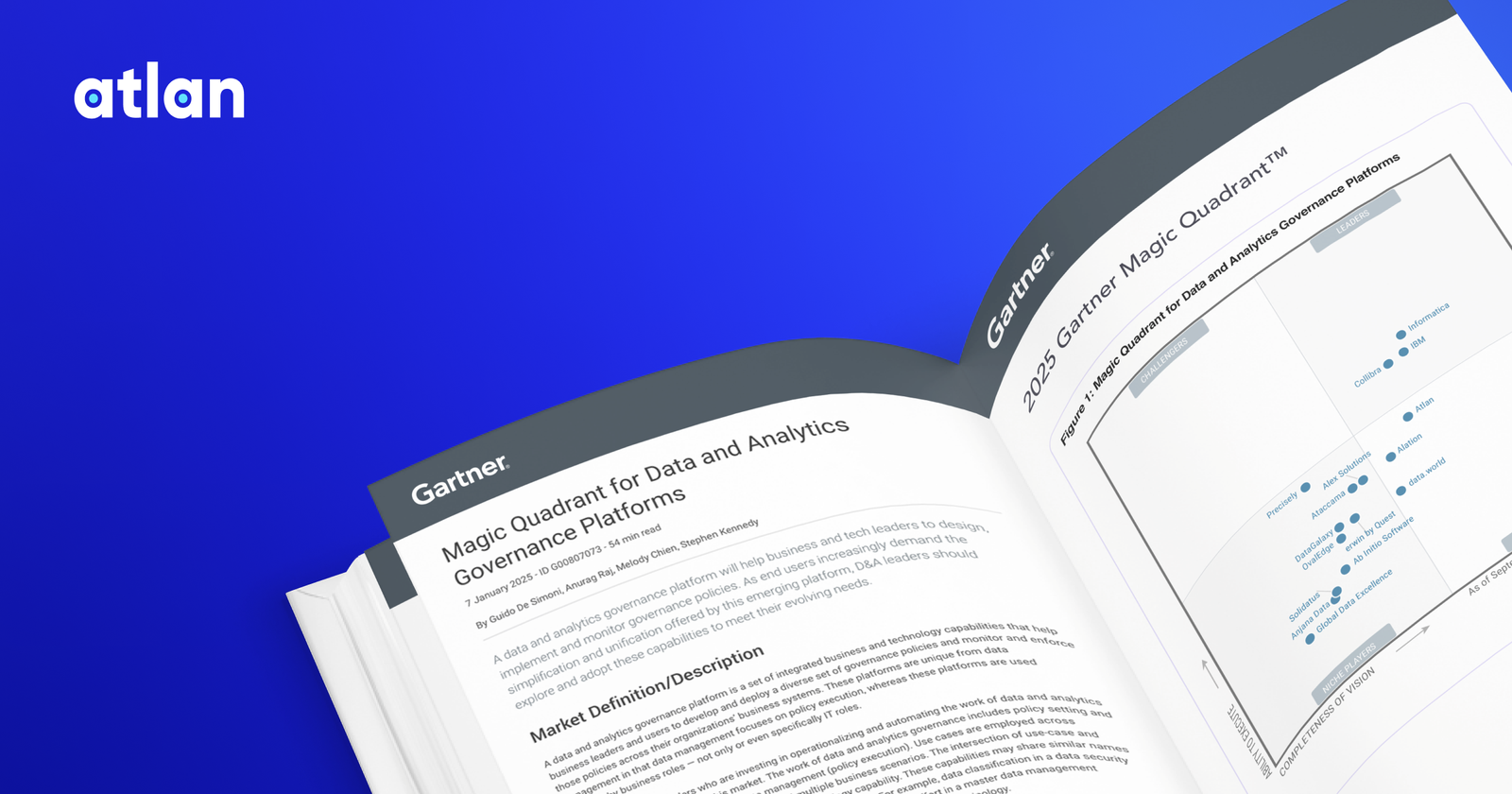
Gartner has just released its first-ever Magic Quadrant for data management and analytics platforms, marking a fundamental shift in how organizations think about governance. And here’s the exciting part – Atlan has been recognized as a Visionary in this inaugural report. This moment underscores a basic reality:
- Management is no longer just an IT issue – it’s a business imperative.
- Artificial intelligence and decentralized data ecosystems are accelerating the evolution of governance.
- Modern management platforms are emerging that unify fragmented tools.
For years, administration was a patchwork of disconnected systems—one for metadata, another for policy, and another for security. But with AI-driven decision making and cloud ecosystems, organizations need a holistic approach to management.
Did you miss the webinar? Watch the recording to see former Gartner analyst Austin Kronz break down MQ, discuss key trends and share practical management strategies.
Why Management Platforms Matter Right Now
The timing of this new Magic Quadrant is particularly exciting—the governance platform market is growing “15% faster than other aspects of data-related segments,” demonstrating the urgent need for more comprehensive governance solutions. Growth in this emerging and developing market is driven by three key factors:
Desire to manage operational and analytical data in a cohesive manner
In the past, organizations viewed operational and analytics data management as completely separate domains, leading to overlapping efforts and confusion. While operations teams focused on managing day-to-day business data, analytics teams maintained their own approaches to business information management and decision making. This separation created redundant processes and inconsistent standards – the same data could be classified or managed differently depending on whether it was used operationally or analytically. Organizations now recognize that this division is artificial and counterproductive. The solution lies in unified management platforms that can seamlessly manage both operational and analytical data through a single set of policies and processes. This unified approach not only removes confusion, but also helps organizations adapt more quickly to evolving data technologies, from cloud data warehouses to real-time analytics platforms, all while maintaining consistent governance standards across the entire data environment.
Increasing complexity of policy management
The historical approach to data management was fundamentally fragmented, with different teams operating in isolation and creating their own silos of governance. Data security teams, master data management teams, and analytics teams have developed their own separate practices and management tools, although they often attempt to solve similar problems. This secretive approach has led to confusion and inefficiencies—for example, data classification can mean one thing in a security context and something completely different for master data management, even though both teams are working toward similar goals. Organizations are now moving away from these separate management forces towards unified management platforms that can serve all teams through a single, consistent framework. This consolidation eliminates redundant efforts and conflicting standards while still supporting the diverse needs of different users, from business analysts to data engineers, all working on the same foundation.
AI as a management accelerator
The emergence of AI has become a major catalyst for governance initiatives. Organizations must consider the ethical and operational challenges specific to AI models, including privacy requirements, model bias, and transparency. This expanded scope of management beyond traditional data management to include AI management requires new frameworks and tools for managing AI assets. Engaging multiple stakeholders, from business users to data scientists, requires governance platforms that can support diverse personalities while ensuring responsible AI development and deployment. This democratization of AI use across organizations has made management more critical and complex, creating a need for sophisticated management platforms that can handle these new challenges.
Market training
What makes this Magic Quadrant particularly interesting is its structure. The wide range of supplier placements, especially on the axis of completeness of vision, reveals a market that is actively defining its future. Notably, there are no challengers in this quadrant, which Kronz interprets as a sign of a “relatively newer emerging market where execution will change and fluctuate from year to year.”
As the data management and analytics platform market continues to evolve and shape, vision and innovation are the key drivers shaping it right now. Implementation models continue to evolve as organizations determine how to operationalize governance most effectively.
This means that adaptability must be a top priority for companies evaluating governance solutions. It is important to choose a platform that is not only built for today’s management requirements, but also for tomorrow’s needs. The most successful platforms will be visionary – focused on where the market is going and able to adapt quickly as management and organizational requirements evolve.
So what are the key trends taking shape as the data management market matures? There are three main forces. Let’s dive deeper into each of these trends to understand how they will redefine data management and analytics in the coming years.
Three critical trends shaping the future
1. Convergence of platforms
The days of power tools of governance are numbered. Organizations are moving towards integrated platforms that can handle different aspects of management in a unified way. This convergence brings together what previously existed in isolation under a single management framework with capabilities that integrate:
- Metadata management
- Data access and security controls
- Policy enforcement
- Line and quality tracking
Creates an end-to-end framework which ensures the setting, enforcement and monitoring of management policies holistically across the entire data ecosystem they use active metadata acting as glue.
For leaders, it means less manual effort, fewer gaps, and a stronger ability to ensure compliance while enabling collaboration. The future of management is not about managing multiple tools, but about choosing a platform that brings it all together.
2. Consumption of governance
“Consumerization is really targeting the types of people who are now involved in governance,” Kronz explains. “We need to move well beyond this IT-focused, technical-type governance role.” This trend reflects the need to make management accessible to business users while maintaining robust controls.
Governance, previously a managed IT function with technical teams defining and enforcing policies, has now become a broader enterprise-wide priority. The old model no longer works. The future of governance is not just for IT – it’s for everyone. Organizations that embrace consumer governance will see faster adoption, better collaboration and stronger compliance across their data ecosystem.
The new wave of management platforms offers:
- Business-friendly experiences such as an intuitive user interface, collaboration tools
- Self-service driving with automatic policy enforcement and natural language queries
- Role-based access and automation so business users can use the control without deep technical knowledge
3. Management of artificial intelligence
Artificial intelligence is a double-edged sword for data management. On the one hand, it brings new risks and challenges that organizations must carefully manage, such as ensuring unbiased training data, validating outputs, preventing malicious use, and maintaining transparency for compliance. Management platforms must evolve to meet the unique needs of AI, with features such as model cataloging, evaluation pipelines, and explainable AI.
However, AI is also a powerful tool for strengthening governance itself. By incorporating artificial intelligence and automation into management workflows, organizations can simplify tasks such as data classification, quality control, and compliance reporting while making management accessible to business users. As data complexity continues to grow, AI-powered automation is an essential accelerator for effective management at scale.
To navigate this duality, organizations need a solid foundation of unified data and AI management. This requires platforms that provide end-to-end lifecycle management for AI, seamless integration between data and model management, integrated AI to augment processes, and intuitive experiences for all stakeholders.
By combining data management and artificial intelligence, businesses see the full potential of AI-based insights as well as proactive risk management.
What’s next for data management?
The emergence of this magic quadrant signals more than just market maturity; it is a fundamental shift in the approach of organizations to management. In the future, successful management platforms will need to:
- Support multiple people across business and technical roles
- Provide flexible, adaptable policy frameworks
- Enable business governance while maintaining technical rigor
- Embed AI management capabilities while leveraging AI to improve management processes
As governance continues to evolve, platforms that can balance these above requirements while remaining accessible to business users will be key for organizations navigating the complexities of modern data and analytics environments.
What this means for your organization
The inaugural Magic Quadrant for Data and Analytics Governance Platforms represents an inflection point. As data and artificial intelligence reshape industries, managing things is not an afterthought. The most successful organizations will be those that adopt a visionary approach to governance that is:
- Comprehensive, unifying data and AI governance across the lifecycle
- Collaboration, stakeholder engagement from the boardroom to the front line
- Intelligent, using AI to streamline management and gain insights
- Adaptable, keeping up with the inexorable evolution of data and analytics
So what does this mean for you? When evaluating your own governance journey, consider these key steps:
- Assess your current state: Conduct a governance maturity assessment to identify strengths, gaps and priorities. Engage stakeholders across the enterprise to understand their needs and challenges.
- Define your vision: Describe what visionary management looks like for your organization. Set bold but achievable goals that align with your overall data strategy and business goals.
- Develop a plan: Create a phased plan for implementing modern management capabilities and balance quick wins with long-term initiatives. Focus on high-impact use cases that will demonstrate value soon.
- Evaluate platforms carefully: Look for management solutions that align with the key trends of AI convergence, consumerization and innovation. Prioritize platforms that can adapt to your evolving needs and scale with your management maturity.
Remember, the journey of governance is never complete. As your business evolves, so must your approach to management. But with the right foundations, you’ll be well equipped to navigate whatever the future holds. At Atlan, we are proud to be recognized as visionaries and to be part of this key transformation in how organizations practice governance. See it in action and book a demo.