
Data collaboration is the backbone of modern AI innovation, especially when organizations work with external partners to uncover new insights. However, data privacy and intellectual property protection remain major challenges to enabling collaboration while protecting sensitive data.
To bridge this gap, customers across industries are using Databricks Clean Rooms to perform shared analysis of sensitive data and make collaboration a priority.
We’ve compiled the 10 most frequently asked questions about cleanrooms below. These discuss what cleanrooms are, how they protect data and IP, how they work across clouds and platforms, and what it takes to get started. Let’s get to it.
1. What is a “clean data room”?
A data cleanup room is a safe environment where you and your partners can work together on sensitive data and gain actionable insights without having to share the underlying sensitive raw data.
In Databricks, you create a clean room, add the resources you want to use, and run only approved notebooks in an isolated, secure, and controlled environment.
2. What are examples of the use of clean spaces?
Clean spaces are useful when multiple parties need to analyze sensitive data without sharing their raw data. This is often due to privacy regulations, contracts or intellectual property protections.
They are used in many industries, including advertising, healthcare, finance, government, transportation, and data monetization.
Some examples:
Advertising and marketing: PII-free identity solutions, campaign planning and measurement, data monetization for retail media and brand engagement.
- Partners such as Epsilon, The Trade Desk, Acxiom, LiveRamp and Deloitte use Databricks clean spaces for identity solutions.
Financial services: Banks, insurance companies and credit card companies combine data for better operations, fraud detection and analysis.
- Examples: Mastercard uses clean spaces to match and analyze PII to detect fraud; Intuit securely matches borrower data with lenders to find qualified borrowers.
Clean spaces protect customer data while enabling collaboration and data enrichment.
3. What kinds of data assets can I share in a cleanroom?
In Databricks Clean Rooms, you can share a wide range of assets managed by the Unity Catalog:
- Tables (Managed, External, and Foreign): structured data such as transactions, events or customer profiles.
- Views: filtered or aggregated parts of your tables.
- Volumes: files such as images, audio, documents, or private code libraries.
- Notebooks: SQL or Python notebooks that define the analysis you want to run.
This is how it looks in practice:
- HAS retailerhas CPG brandaa market research firm share anonymized impressions, including: hashed customer IDs, aggregated sales metrics, and regional demographics to jointly analyze campaign impact.
- HAS streaming platform and advertising agency share campaign impression spreadsheets and a notebook that calculates audience metrics for different platforms.
- HAS flask aa fintech partner share volumes containing ML risk and fraud models and use a notebook to evaluate models together, keeping individual entries private.
4. How does it compare to Delta sharing? Why should I use a clean room instead?
Think of it this way: Delta Sharing is the right choice when one party needs read-only access to data in its own environment and is comfortable seeing the underlying records.
Cleanrooms add a secure, controlled space for multi-party analysis when data must remain private. Partners can connect data assets, run mutually agreed-upon code, and return only outputs that all parties agree on. This is useful when you need to meet strict privacy safeguards or support regulated workflows. In fact, data shared in cleanrooms still uses the Delta Sharing protocol behind the scenes.
For example, a retailer can use Delta Sharing to give a supplier read-only access to a sales table to see how products are being sold. The same pair would use the Clean Room when they need to connect richer and more sensitive data from both sides (such as customer characteristics or detailed inventory), run approved notebooks, and share only aggregated outputs such as demand forecasts or top-risk items.
5. How is sensitive data and IP protected in a clean room?
Clean spaces are created so that your partners will never see your raw data or IP. Your data stays in your own Unity catalog, and you only share specific assets in the cleanroom via Delta sharing, which is managed by approved laptops.
To enforce these protections in a clean room:
- Collaborators see only the schemas (column names and types), not the actual row-level data.
- Only laptops that you and your partners approve can run on serverless machines in a sandbox.
- The notebooks write to temporary output tables, so you are in control of exactly what is leaving the cleanroom.
- Outbound network traffic is restricted through serverless egress controls (SEGs).
- To protect IP or proprietary code, you can package your logic as a private library, store it in a Unity Catalog volume, and reference it in cleanroom notebooks without revealing your source code.
6. Can collaborators on different clouds join the same clean room?
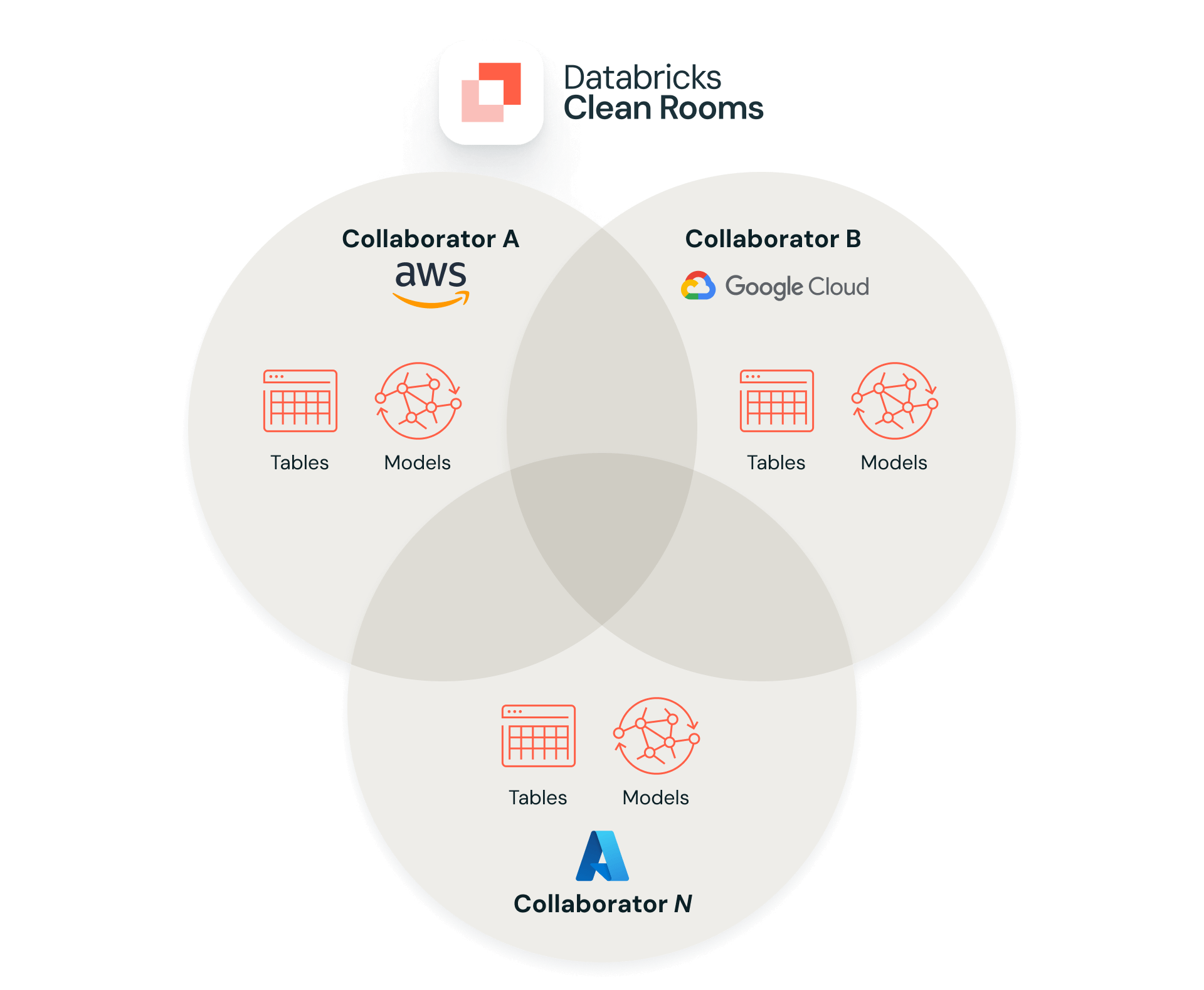
Yes. Cleanspaces are designed for multi-cloud and cross-region collaboration as long as each participant has a Unity catalog enabled workspace and Delta sharing on their metastore. This means that an organization using Databricks in Azure can collaborate in a clean room with partners on AWS or GCP.
7. Can I bring data from Snowflake, BigQuery or other platforms to the cleanroom?
Yes, absolutely. Lakehouse Federation exposes external systems like Snowflake, BigQuery, and traditional repositories as foreign catalogs in the Unity Catalog (UC). Once external tables are available in UC, you share them in the cleanroom the same way you share any other table or view.
Here’s how it works at a high level: You use Lakehouse Federation to create connections and foreign catalogs that expose external data sources in the Unity Catalog without having to copy all that data into Databricks. Once these external tables are available in the Unity catalog, you can share them in the cleanroom just like any other table or view managed by the Unity catalog.
8. How do I run my own common data analysis?
Inside the cleanroom, you do almost everything via laptops. You add a SQL or Python notebook that contains the code for the analysis you want, your partners review and approve the notebook, and then it’s ready to run.
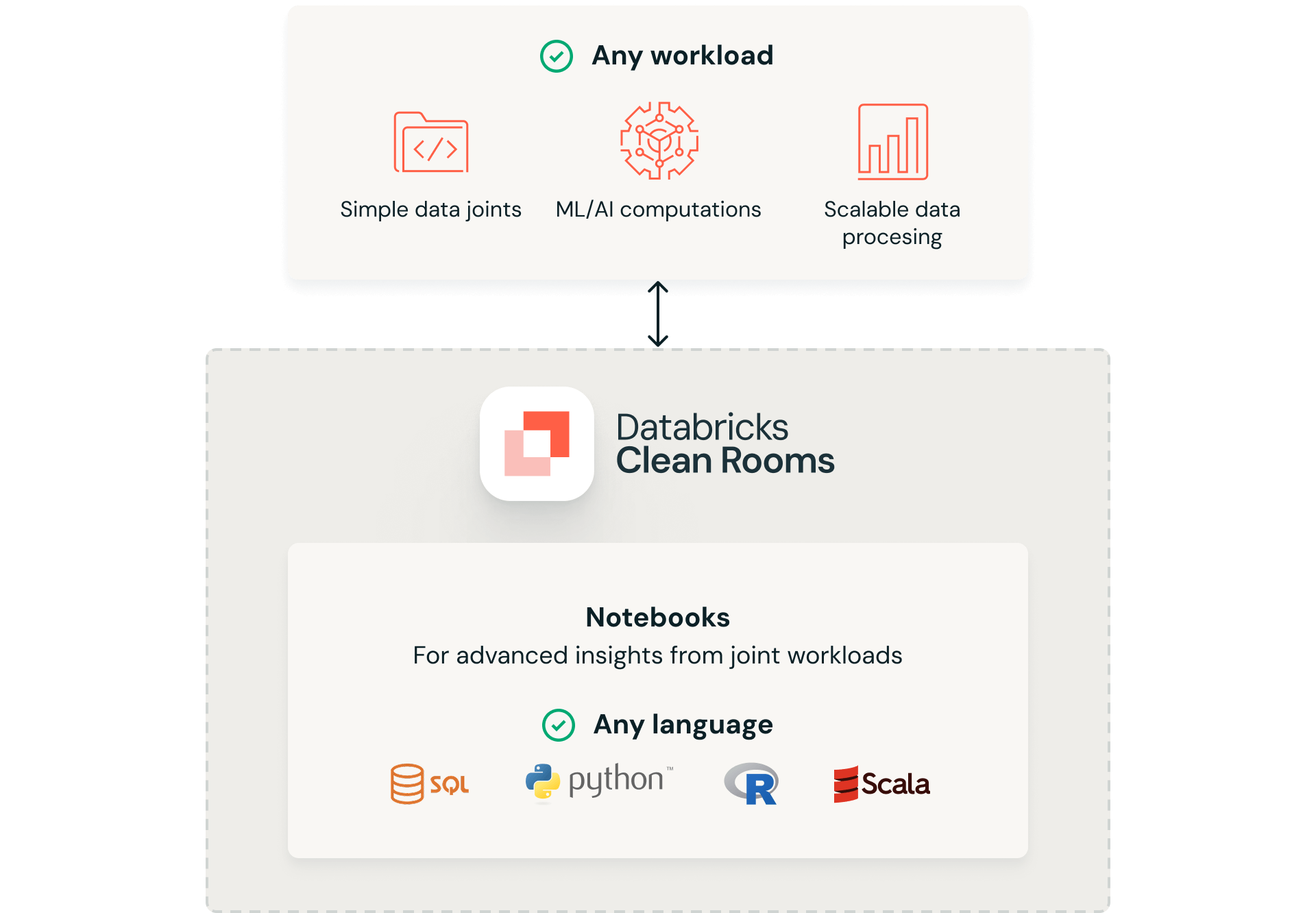
Simple case: maybe you have a SQL notebook that counts the overlapping hash IDs between a retailer’s purchases and a media partner’s impressions, and then spits out reach, frequency, and conversion.
More advanced: use a Python notebook to combine functions from both sides, train or evaluate a model on the combined data, and write predictions to an output table. An approved runner sees the outputs, but no one sees the other party’s raw logs.
9. How does multi-party collaboration work?
In a Databricks cleanroom, you can have up to 10 organizations (you plus 9 partners) working together in one secure environment, even if you’re on different clouds or data platforms. Each team keeps their data in their own Unity catalog and only shares the specific tables, views, or files they want to use in the cleanroom.
Once everyone is involved, each party can offer SQL or Python notebooks, and these notebooks need approval before they can run, so the logic suits all parties.
10. So that sounds good. How do I get started?
Here’s a simple way to get started:
- Check that your workspace has Unity Catalog, Delta Sharing, and serverless computing enabled.
- Create a Clean Room object in your Unity Catalog metarepository and invite your partners with their share IDs.
- Each party will add the data assets and laptops they want to collaborate on.
- Once everyone has approved the notebooks, run the analysis and review the outputs in your own meta repository.
Watch this video to learn more about creating a clean room and how to get started.